
Curcumin derivative · ATP5A · Research compound
J147: the cure for autism from Panacea Bio Chem?
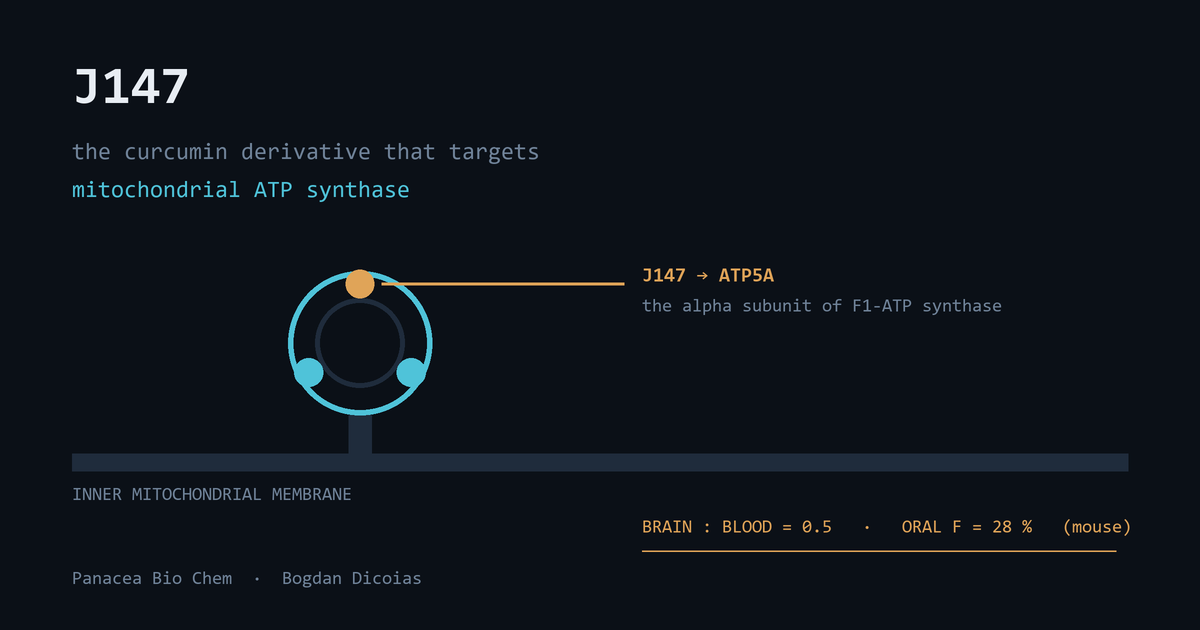
It is a question, and the honest answer is that nobody knows, because nobody has run the experiment. There is no published research on J147 in autism in any language. What exists is a molecule whose target is the alpha subunit of mitochondrial ATP synthase (ATP5A), which acts on three mechanisms autism research works on separately, and a completed Phase 1 whose results were never published.
Panacea Bio Chem holds that convergence as a research thesis and is proposing the experiment. The platform is NEUROCONVERGE™; J147 is its first candidate.
This site is a record of what is actually known about J147, where that knowledge came from, and what has never been tested. Every claim on it traces to a named primary source — including the ones that say nobody has looked.
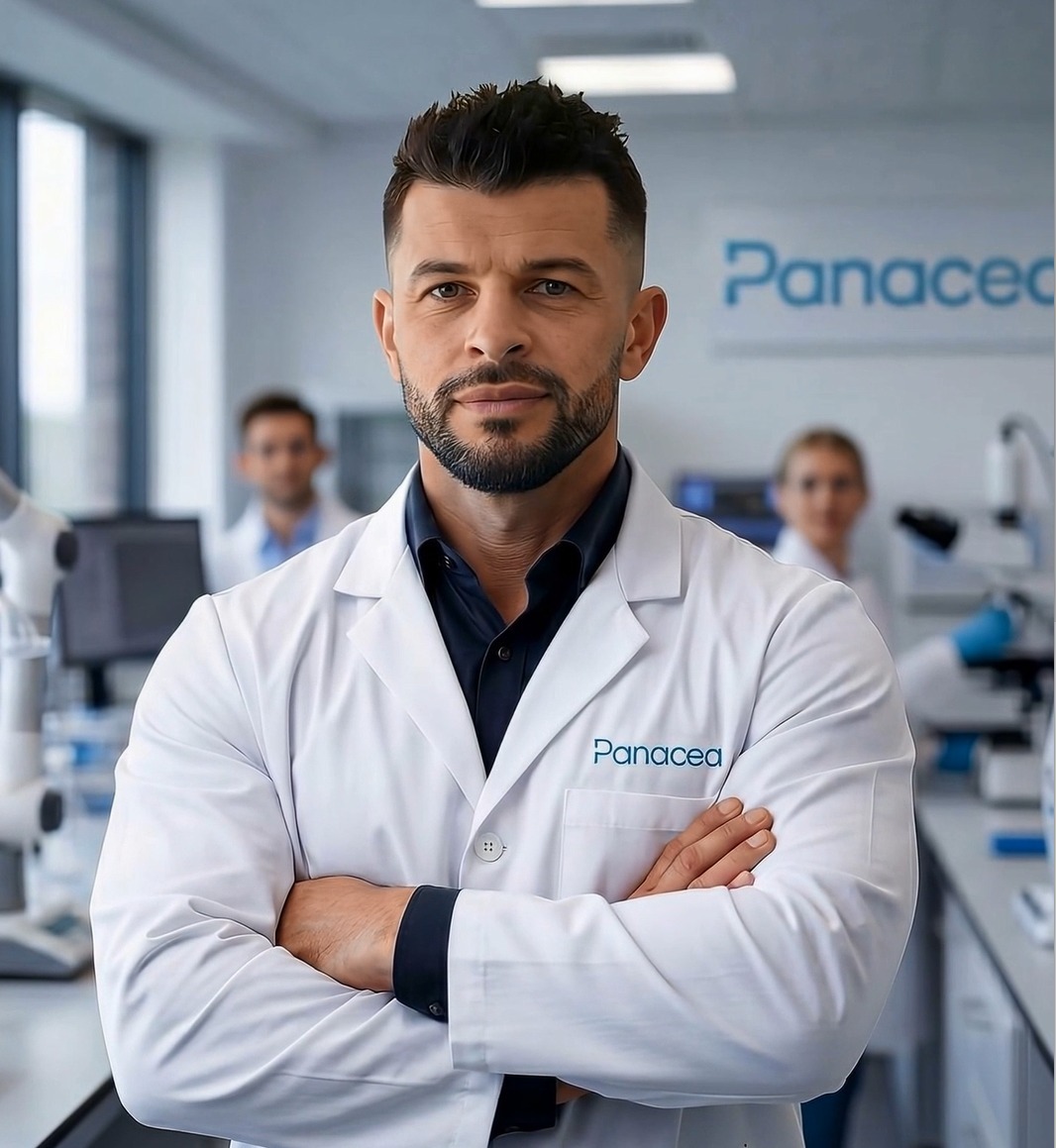
“Curcumin was never the medicine. It was the hint. J147 is what happened when chemists took the hint seriously — the Salk labs found the molecule and then found its target, and Abrexa took it through a Phase 1 whose results were never published.
J147 did not fail. It was parked. A compound that is twenty-eight per cent orally available, with a ninety-minute half-life in plasma, was never going to succeed on a formulation somebody else thought was good enough. That part — synthesis, purity, stability, and getting the dose where it is supposed to go — is ours.”
Bogdan Dicoias — biochemist and inventor · Director of Panacea Bio Chem Ltd
A molecule that failed to be curcumin
Curcumin has been the subject of an enormous and largely disappointing literature. It is unstable, poorly absorbed, and promiscuous enough to register as a hit in assays it has no business passing. The sensible conclusion was that curcumin is not a medicine.
The Salk Institute drew a different conclusion: that curcumin was a hint. In 2011 a medicinal-chemistry programme built derivatives and pushed them through cell-based phenotypic screens modelled on the toxicities of the old brain — not on amyloid, not on a single receptor. J147 came out of that programme with neurotrophic activity in assays where curcumin has none, and with the stability and bioavailability curcumin lacks.
Screened against ageing, not against a hypothesis
This is the part that matters and the part most summaries skip. J147 was not designed against a theory of Alzheimer's disease. It was selected for what it did to cells under old-age-associated stress. That is why its eventual target came as a surprise, and why it turned out to be a target that ageing and dementia share.
Next: the mechanism How a phenotypic screen led to ATP synthase — and what binding ATP5A actually does to a cell.The numbers that define the problem
Four measured values from the mouse pharmacokinetics decide what kind of molecule this is:
Single 20 mg/kg dose in mice, reported alongside the aged-mouse efficacy work in Alzheimer's Research & Therapy, 2013. These are not deficiencies to be apologised for. They are a specification.
What happened next, and what didn't
J147 completed the animal toxicology required to enter human trials. Abrexa Pharmaceuticals, holding the Salk licence, ran a Phase 1: a randomised, double-blind, placebo-controlled study of single ascending oral doses in 64 healthy young and elderly volunteers. It began in January 2019 and completed in February 2020.
No results have been posted to the registry, and no
peer-reviewed publication of the outcome was found. The trial
record carries hasResults: false. No Phase 2 study of J147 is
registered. That is a statement about the public record, not about anyone's
conduct — but it is why a compound with this much preclinical support is
still, in 2026, a research chemical.
One detail in the trial record is worth the attention of anyone who formulates: the placebo was a single oral dose of corn oil. The only human study of J147 was built on an oil vehicle.
NEUROCONVERGE™ — the platform, and why this comes from Panacea Bio Chem
A molecule that is 28 % orally available with a 90-minute plasma half-life is a molecule whose formulation is the science. That is the half of J147 nobody finished, and it is the half Panacea Bio Chem was built for: synthesis, analytical characterisation, purity, stability, and what the compound does once it is in a vial.
The programme runs on our own machines, every one of them invented by Bogdan Dicoias. SYNTHESERACT™ synthesises the compound. Lyochrysalis™ dries it, and inside Lyochrysalis LyoLevit™ lifts the cake off the shelf entirely — zero-contact orbital sublimation, heat arriving as 360° radiation instead of floor conduction, and a sublimation surface that goes from the top face alone to very nearly the whole cake. The dried product is sealed in a Lyoprester™: a two-chamber pre-filled syringe holding the cake under vacuum and argon in one chamber and its P-EARL™ reconstitution liquid in the other, so tapping the plunger draws the liquid into the cake in situ, with no separate mixing step. What goes into that cartridge is not argued, it is computed: Dicoias Ψ™, our own formulation mathematics, reduces every substance and every excipient to a vector on the same six axes of protective demand and scores the recipe as a shortfall energy; Peptourbillon™ turns that into masses and volumes; and S3Pulse™ runs the machine and keeps the run record. J147 is a research compound in an ongoing, directional programme; no result is claimed for it here.
That programme has a name. NEUROCONVERGE™ is the Panacea Bio Chem platform built on the convergence of neurotrophic signalling, microglial neuroinflammation and mitochondrial energetics, and J147 is the first candidate we are taking through it.
The first goal is an exposure-controlled dose of J147 that a laboratory can rely on. The next is the first honest experiment in a model nobody has run it in. The ultimate goal is an answer to a question nobody has asked.
The programme in full NEUROCONVERGE™, the three-mechanism thesis, and the experiment Panacea Bio Chem is proposing. Next: formulation and capability What a 1.5-hour half-life demands of a dosage form, and which of our technologies bear on it.The work we are standing on
Nothing on this site is Panacea's discovery, and the credit is not a footnote:
Salk Institute
The Cellular Neurobiology Laboratory — David Schubert and Pamela Maher, with Marguerite Prior, Antonio Currais, Joshua Goldberg, Chandramouli Chiruta and colleagues. They built the screen, made the molecule, ran the aged-mouse work, and identified ATP5A. The patent naming Maher and Schubert was filed in July 2016.
Abrexa Pharmaceuticals
Licensed the Salk position and did the thing nobody else did: took J147 into a human being, under a randomised, placebo-controlled protocol, in both young and elderly volunteers. NCT03838185.
Chinese research groups
The most active recent J147 literature is Chinese and is under-cited in the West. Fang Qiu, Yanmei Wang, Yunbo Du, Changchun Zeng, Yuqiang Liu, Haobo Pan and Changneng Ke — Shenzhen Second People's Hospital, Guangdong Medical University, and the Center for Human Tissues and Organs Degeneration — published the 2023 review that consolidates the field. Separate Chinese groups have taken J147 into sepsis-induced neuroinflammation, depression, diabetic neuropathy and stroke.
Russian-language literature
We searched CyberLeninka, eLibrary and the Russian neurological journals in Russian, and found no primary Russian research on J147. What exists is secondary and popular. We say so because a silence you cannot see looks like a search nobody ran.
Research use only
J147 is an investigational compound. It is not approved as a medicine in any territory, it is not supplied here for human use, and nothing on this site is dosing advice. Nothing here is medical advice.
Trending in the field
Recent developments in the field — refreshed 2026-09-29 by Panacea Bio Chem.
- Therapeutic Potential of Pioglitazone in a Propionic Acid-Induced Rat Model of Autism Spectrum Disorder: The Role of the SIRT1/PPAR-γ Axis — PubMed, 2026 Oct
- Cunermuspir, a Copper(I)-Niacin Complex, Modulates Mitochondrial Respiration and Cellular Oxidant Handling in Fibroblasts from Children with Autism Spectrum Disorder — PubMed, 2026 Sep 10
- CRISPR-Enabled functional genomics in hPSCs-derived neural models for autism spectrum disorder — PubMed, 2026 Sep 16
- Ultrastructural remodeling of mitochondria-associated vesicular structures in the rat medial prefrontal cortex following Propionic acid exposure — PubMed, 2026 Sep 6
References
- Goldberg J, Currais A, Prior M, Schubert D, Maher P, et al. “The mitochondrial ATP synthase is a shared drug target for aging and dementia.” Aging Cell 2018;17:e12715.
- Prior M, Dargusch R, Ehren JL, Chiruta C, Schubert D. “The neurotrophic compound J147 reverses cognitive impairment in aged Alzheimer's disease mice.” Alzheimer's Research & Therapy 2013;5:25.
- ClinicalTrials.gov NCT03838185 — Phase 1 single ascending oral doses of J147 (Abrexa Pharmaceuticals).
- Qiu F, Wang Y, Du Y, Zeng C, Liu Y, Pan H, Ke C. “Current evidence for J147 as a potential therapeutic agent in nervous system disease: a narrative review.” BMC Neurology 2023.
- Salk Institute — “Alzheimer's drug turns back clock in powerhouse of cell.”
- WO2017015660A1 — “Prevention and treatment of aging and neurodegenerative diseases”, Salk Institute for Biological Studies; inventors Maher PA, Schubert DR; filed 25 July 2016.



